
Insights
Light gauge steel, explained.
Clear, specific answers on light gauge steel (LGS) framing, modular and panelized construction, and how it performs for housing across Southern California, drawn from real projects we have built.
Start with the pillar: an overview of light gauge steel framing in Southern California, then go deeper on the question you have.
Comparison
Light Gauge Steel vs. Wood Framing: Cost, Speed, Fire, and Durability
Light gauge steel (LGS) framing is non-combustible, dimensionally stable, and well suited to prefabrication, which can cut framing schedules and field crews dramatically versus wood. Wood is often cheaper in raw material and labor for small, simple builds, but LGS pulls ahead on fire safety, speed at scale, consistency, and durability, especially for multifamily, hotels, and California fire rebuilds.
Read7 minFire & resilience
Is Light Gauge Steel Fire-Resistant? LGS for California Fire Rebuilds
Light gauge steel is non-combustible: it does not ignite, burn, or feed a fire, and it is unaffected by the wind-driven embers that destroy most homes in California wildfires. That makes load-bearing LGS framing one of the strongest structural choices for rebuilding in fire-prone areas like the Eaton and Palisades burn zones.
Read6 minCase study
How Fast Is Light Gauge Steel Construction? The Harvard Yard Case
Light gauge steel construction is fast because the framing is prefabricated off-site and assembled in panels. On our Harvard Yard project in Los Angeles, switching an identical building phase from wood to load-bearing LGS cut the framing schedule from 156 days to 85 days and the field crew from 85 to 25, with about 60 percent of the framing built in the factory.
Read6 minADUs
Light Gauge Steel for ADUs in Los Angeles and Southern California
Light gauge steel is an excellent framing system for accessory dwelling units (ADUs) in Los Angeles and Southern California: it is non-combustible, dimensionally stable, and ideal for the panelized, factory-built approach that lets an ADU go up fast on a tight residential lot. It suits both single-family backyard ADUs and multifamily ADU programs on apartment properties.
Read6 minHotels & senior living
Light Gauge Steel for Hotels and Senior Living in California
Light gauge steel is a strong fit for hotels and senior-living buildings: their repeatable room layouts are ideal for panelized prefabrication, which compresses the schedule and shrinks field crews while delivering a non-combustible, durable, quiet structure. We have built hotels and senior communities across California in panelized LGS, including the Hilton Garden Inn, Marriott Springhill Suites, and two Merrill Gardens communities.
Read6 minMethods explained
Panelized vs. Volumetric Modular vs. Site Framing: What's the Difference?
Site framing builds the structure piece by piece on site. Panelized construction builds wall, floor, and roof panels in a factory and assembles them on site. Volumetric modular builds complete three-dimensional room modules in the factory and sets them on the foundation. Panelized and volumetric both move work off the jobsite into a controlled factory, which speeds delivery and improves consistency, most of all when the design repeats.
Read6 minMultifamily
Does Light Gauge Steel Work for Mid-Rise Multifamily? Type III and Podium
Yes. Load-bearing light gauge steel is well suited to mid-rise multifamily over a concrete podium (Type III construction), and switching from wood to LGS can add density. On the 8th & Grand project in Los Angeles, redesigning a wood scheme to load-bearing light gauge steel took the building from five to six storeys and from 500 to 700 units.
Read6 minEngineering
Seismic Performance of Light Gauge Steel in California
Light gauge steel performs well under California's seismic demands for two main reasons: steel is strong and ductile relative to its weight, and a lighter building attracts lower seismic forces in an earthquake. Combined with engineered connections designed to code, that makes load-bearing light gauge steel a sound structural choice in seismic zones.
Read5 minThe factory
From Master Coil to Finished Module: How the Owned Steel Factory Works
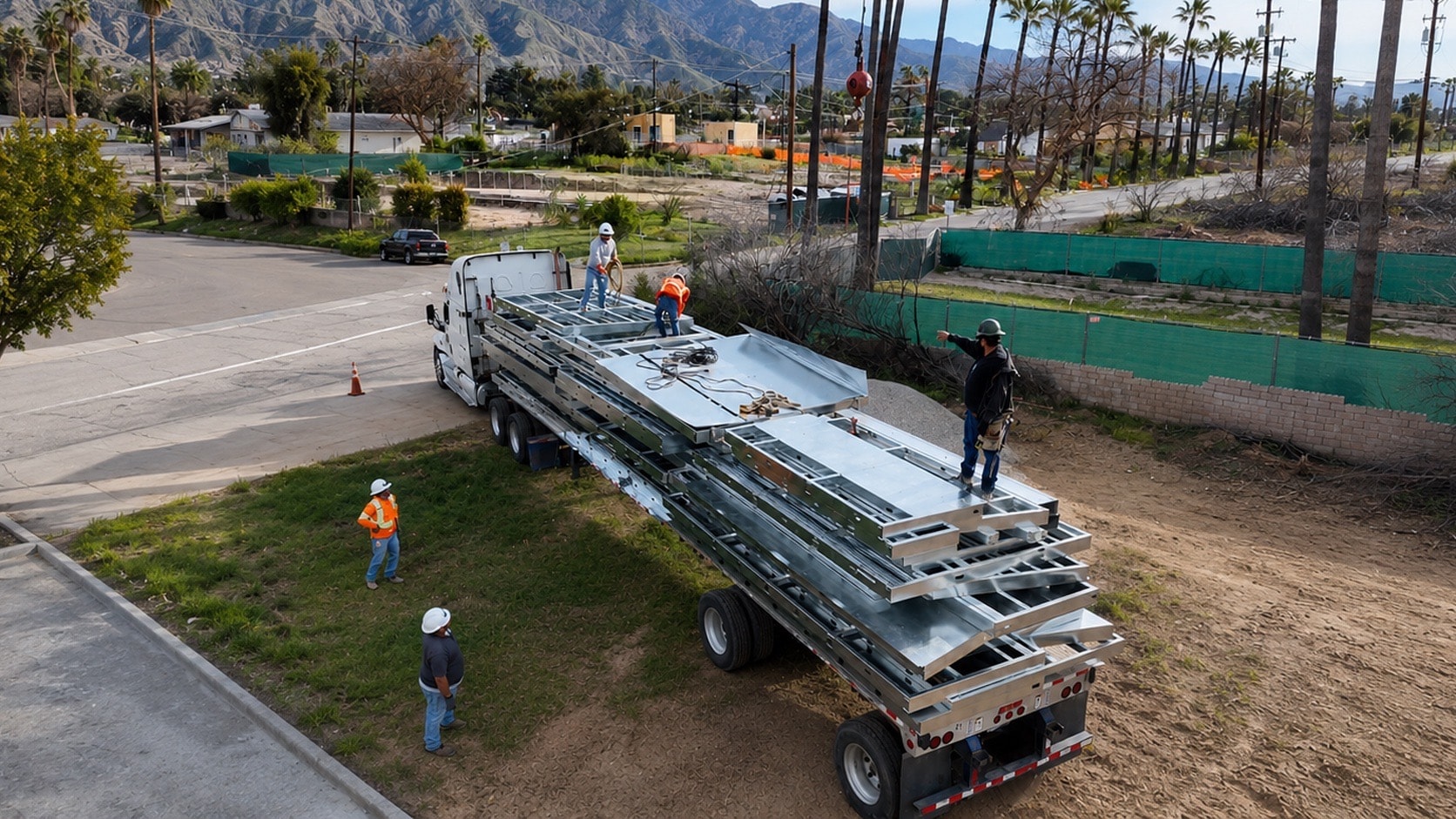
TESH Group owns its off-site steel factory through Cal Steel Modular. The production chain runs from master steel coil, to slitting, to roll-forming into studs and tracks, to panelizing into wall, floor, and roof systems, which either ship flat for on-site assembly or are built up into complete volumetric modules. Owning that chain controls lead time, quality, and cost.
Read5 minFire & resilience
Chapter 7A and the California WUI Code, Explained for Fire Rebuilds
Chapter 7A is the name almost everyone still uses for California's wildfire construction rules, but as of January 1, 2026 the requirements no longer live there. They moved into a standalone code, the California Wildland-Urban Interface Code (Title 24, Part 7), which sets ignition-resistant requirements for roofs, vents, gutters, walls, windows, doors, decks, and the ground around the house. A non-combustible light gauge steel frame is the natural structural partner to those assemblies.
Read8 minFire & resilience
Does Insurance Cover Rebuilding with Steel After a Fire?
In most cases homeowners can rebuild with light gauge steel using their fire insurance proceeds, because policies generally pay to rebuild a comparable home to current code rather than dictating the framing material. Replacement cost and code-upgrade (ordinance or law) coverage often help close the gap between an older home and today's requirements. Every policy is different, so confirm the specifics with your carrier.
Read6 minFire & resilience
The California Fire Rebuild Timeline, Step by Step
A California fire rebuild generally moves through debris removal, site and soils assessment, design and engineering, permitting, and then construction. Building with prefabricated light gauge steel can compress the overall timeline, because panels and modules are fabricated in the factory in parallel with site and permitting work rather than after it.
Read6 minFire rebuild
Eaton Fire Rebuild in Altadena: Building Back with Light Gauge Steel
Homeowners rebuilding in Altadena and the Eaton fire burn area can build back with non-combustible light gauge steel, a structural system that directly addresses the wind-driven embers behind the January 2025 losses. LGS pairs with Chapter 7A wildfire-hardening and can shorten the rebuild through factory prefabrication, which matters when an entire community is rebuilding at once.
Read5 minFire rebuild
Pacific Palisades Fire Rebuild with Light Gauge Steel
Homeowners rebuilding after the January 2025 Palisades fire can build back with non-combustible light gauge steel, a structural system suited to the area's combined wildfire, hillside, and coastal exposure. LGS pairs with Chapter 7A wildfire-hardening and, where sites are steep, works alongside structural steel for hillside foundations and frames.
Read5 minFire rebuild
Malibu Fire Rebuild: Non-Combustible Steel for Coast and Hillside
Malibu has faced repeated wildfires, and homeowners rebuilding along its coast and hillsides can build back with non-combustible light gauge steel. LGS resists ember ignition, stands up to the coastal environment, and works with structural steel on steep lots, all within Chapter 7A wildfire-hardened assemblies.
Read5 min