
Case study
How Fast Is Light Gauge Steel Construction? The Harvard Yard Case
Light gauge steel construction is fast because the framing is prefabricated off-site and assembled in panels. On our Harvard Yard project in Los Angeles, switching an identical building phase from wood to load-bearing LGS cut the framing schedule from 156 days to 85 days and the field crew from 85 to 25, with about 60 percent of the framing built in the factory.
TESH Group6 min read
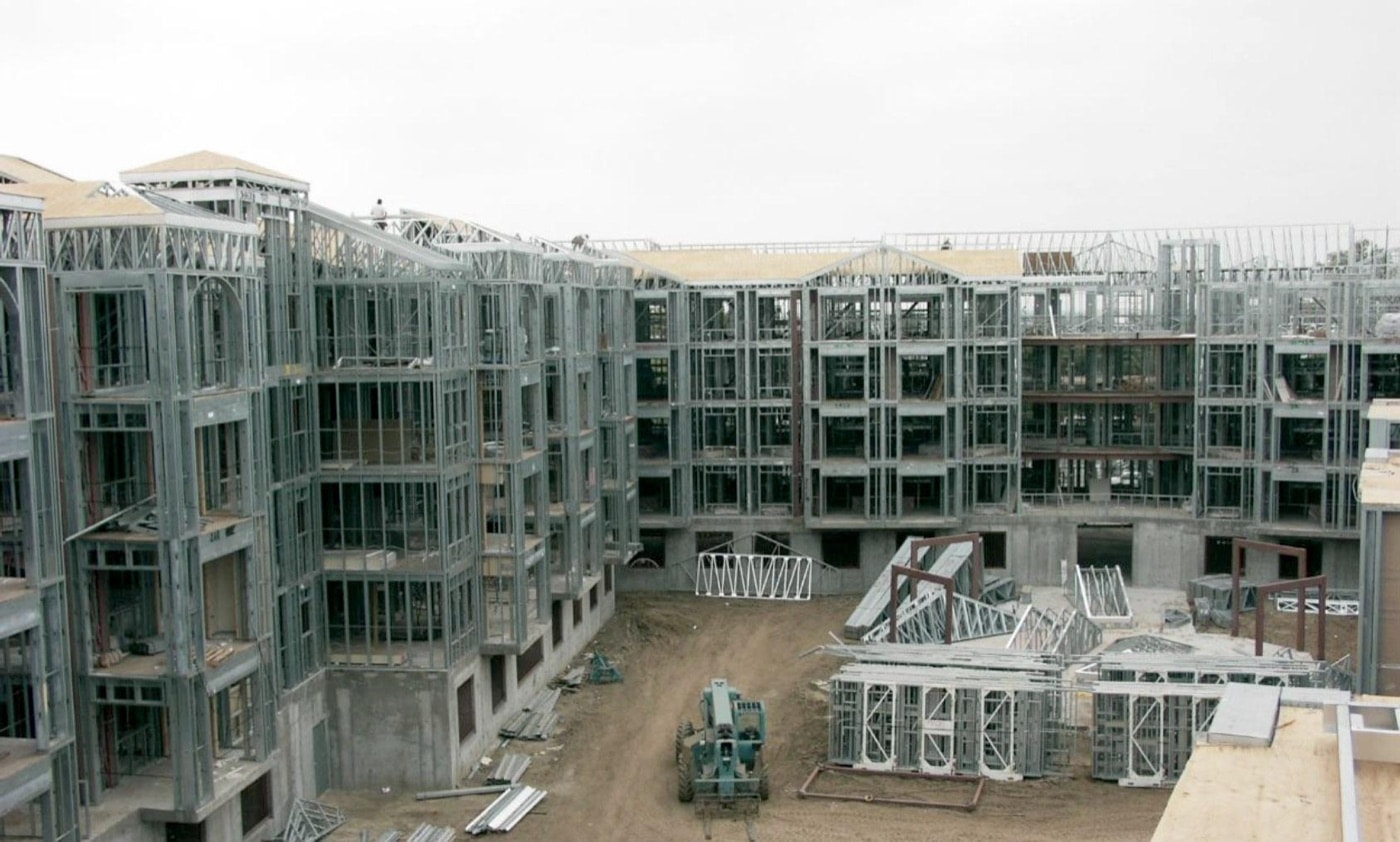
Speed claims about prefabrication are easy to make and hard to verify, because no two buildings are identical. Harvard Yard is the rare project that gives a clean comparison: two mirror-image phases, one framed in wood and one in light gauge steel, on the same site with the same design.
The Harvard Yard comparison
Harvard Yard is a two-phase multifamily development at 8711 S. Harvard Drive in Los Angeles. Each phase is a 273,000 SF building, four levels over a concrete podium. The first phase was framed in wood as originally designed. Our team redesigned the second phase, a mirror image of the first, in load-bearing light gauge steel panels.
| Metric | Phase 1 (wood) | Phase 2 (light gauge steel) |
|---|---|---|
| Working days to top out | 156 | 85 |
| Field crew size | 85 | 25 |
| Framing prefabricated off-site | None | ~60% |
Why does prefabrication make it so much faster?
- Factory and field run in parallel: panels are produced off-site while site work and the podium proceed, instead of one after the other.
- Weather stops mattering: framing happens indoors in a controlled environment, so rain and heat do not stall the schedule.
- Fewer, more skilled hands: panels arrive ready to set, so a small field crew assembles rather than cuts and builds piece by piece.
- Consistency removes rework: factory tolerances mean panels fit, so there is less on-site adjustment and fewer callbacks.
Does a smaller crew mean lost jobs?
It shifts the work, it does not delete it: labor moves from the open site into the factory, and the field crew becomes a skilled assembly team. On Harvard Yard we also provided field training for the original wood framers, who finished their phase on schedule.
Does the speed scale to other building types?
Yes. The same panelized and modular light gauge steel approach drives hotels, senior living, and ADU programs, where repetition multiplies the schedule benefit. The more a design repeats, the more the factory pulls ahead of stick-building on site.
Frequently asked questions
- How much faster is light gauge steel than wood framing?
- On the Harvard Yard project, an identical building phase framed in light gauge steel topped out in 85 working days versus 156 days in wood, a roughly 45 percent reduction in framing schedule.
- Why is prefabricated steel construction faster?
- Panels are built in a factory while site work proceeds in parallel, the work is unaffected by weather, and panels arrive ready to assemble, so a smaller field crew sets them quickly with little rework.
- Does building faster mean lower quality?
- No. The speed comes from factory precision and parallel scheduling, not shortcuts. Factory-built panels are produced to tighter tolerances than field framing, which typically improves quality and reduces callbacks.
Build with light gauge steel