
Comparison
Light Gauge Steel vs. Wood Framing: Cost, Speed, Fire, and Durability
Light gauge steel (LGS) framing is non-combustible, dimensionally stable, and well suited to prefabrication, which can cut framing schedules and field crews dramatically versus wood. Wood is often cheaper in raw material and labor for small, simple builds, but LGS pulls ahead on fire safety, speed at scale, consistency, and durability, especially for multifamily, hotels, and California fire rebuilds.
TESH Group7 min read
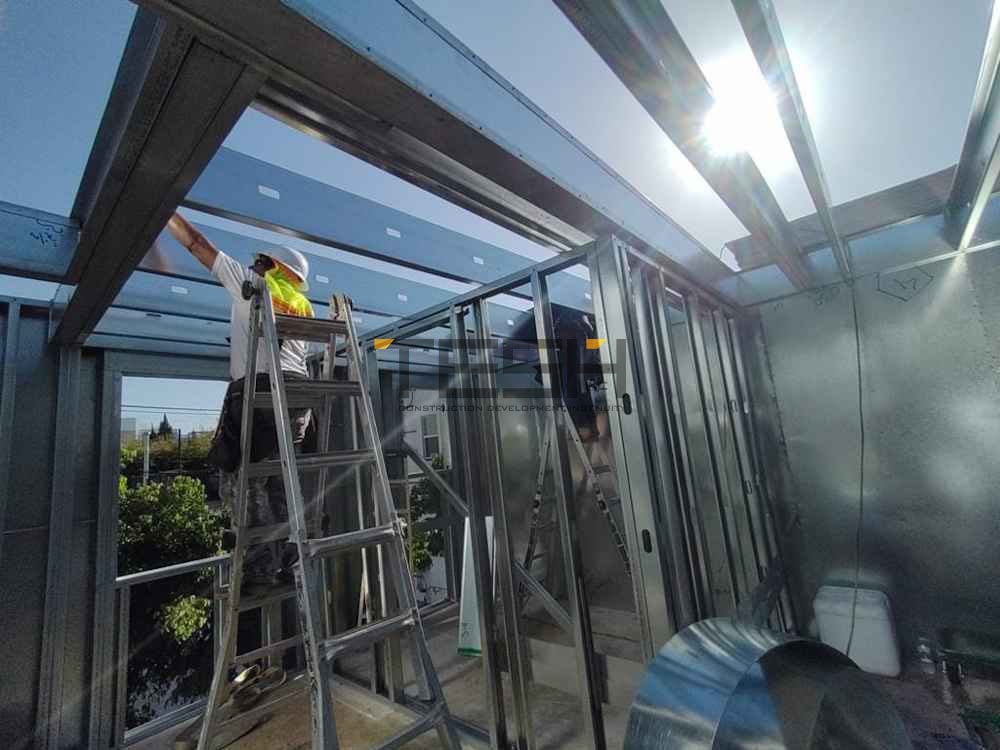
Choosing between light gauge steel (also called cold-formed steel, or CFS) and dimensional lumber is one of the first real decisions on a California housing project. The honest answer is that it depends on the building, but the trade-offs are consistent and quantifiable. Here is how the two compare on the factors that actually drive a decision.
Is light gauge steel more expensive than wood?
On raw material and a small, simple structure, wood framing usually carries a lower first cost. Where light gauge steel closes and often reverses that gap is at scale and over the life of the building: smaller field crews, faster schedules, near-zero material waste from a controlled factory, no warping or callbacks, lower insurance exposure on non-combustible construction, and no loss to termites, rot, or moisture. On larger and repetitive buildings (multifamily, hotels, senior living), the total delivered cost frequently favors LGS once schedule and crew savings are counted.
Which is faster to build?
This is where light gauge steel separates itself most clearly, because LGS panels and components are built to be prefabricated. On our Harvard Yard project in Los Angeles, two mirror-image phases let us measure it directly: the wood-framed phase took a crew of 85 framers 156 working days to top out; the identical second phase, redesigned in load-bearing LGS panels with roughly 60 percent of the framing prefabricated off-site, topped out in 85 working days with a field crew of 25.
| Metric | Wood framing (Phase 1) | Light gauge steel (Phase 2) |
|---|---|---|
| Days to top out | 156 days | 85 days |
| Field crew | 85 framers | 25 framers |
| Prefabricated off-site | None | ~60% |
How do they compare on fire?
Light gauge steel is non-combustible: it does not ignite, feed, or spread fire, and it is unaffected by embers, which is the dominant ignition path in California wildland-urban interface fires. Wood is combustible and, in fire-prone zones, depends heavily on assemblies, cladding, and detailing to achieve the same protection. For fire rebuilds in areas like the Eaton and Palisades burn zones, non-combustible LGS framing is a structural answer to the exact hazard that destroyed the prior home.
What about durability and consistency?
- Dimensional stability: steel studs do not shrink, warp, twist, or split, so finishes stay flat and callbacks drop.
- Pests and rot: LGS is immune to termites and will not rot, a meaningful advantage over the service life of the building.
- Seismic performance: steel's high strength-to-weight ratio and ductility suit California seismic demands; lighter structures attract lower seismic forces.
- Quality control: factory-built panels are produced to tight tolerances in a controlled environment, not cut and assembled in the weather.
When does each one make sense?
Wood can still be the pragmatic choice for a single small structure where first cost dominates and fire exposure is low. Light gauge steel is the stronger answer when fire performance matters, when the schedule is on the critical path, when the design repeats (multifamily, hotels, senior living, ADU programs), or when the project benefits from moving labor off a tight, expensive site and into a factory.
On a like-for-like building, our LGS redesign of Harvard Yard cut the framing schedule by 45 percent and the field crew by more than two-thirds.
Frequently asked questions
- Is light gauge steel stronger than wood?
- Steel has a far higher strength-to-weight ratio than wood and does not weaken with moisture, pests, or age, so light gauge steel framing carries load reliably with less material and is well matched to California seismic demands.
- Does light gauge steel cost more than wood framing?
- Raw material and small-project labor often favor wood, but light gauge steel frequently wins on total delivered cost for larger or repetitive buildings once faster schedules, smaller crews, near-zero waste, and lower fire-insurance exposure are counted.
- Is steel framing better for fire safety?
- Yes. Light gauge steel is non-combustible, so it does not ignite or spread fire and is unaffected by the embers that drive most California wildfire losses, which is why it is widely chosen for fire rebuilds.
Build with light gauge steel